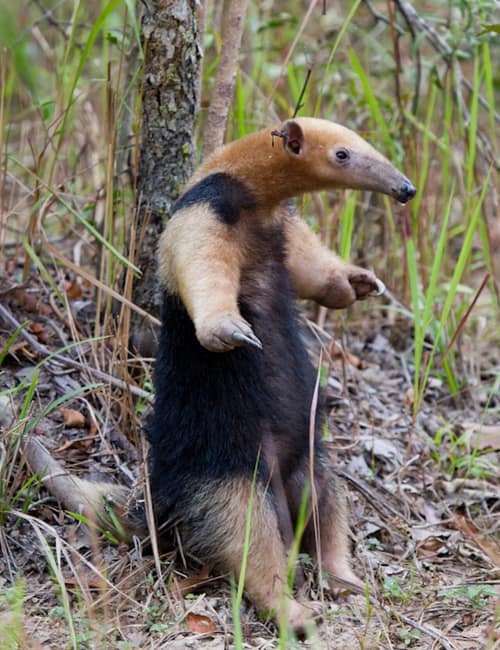
Southern tamanduas spend much of their lives navigating tree canopies and forest floors, using their prehensile tails as an agile fifth limb. When foraging, they tear open insect mounds with robust, curved claws before flicking a sticky, 40-centimeter tongue into crevices to lap up thousands of ants and termites each day. If cornered by a predator, they rear up on their hind legs and spread their arms wide in a tripod stance, ready to deliver powerful defensive slashes.
ThreatsHabitat fragmentation, wildfires, vehicle collisions, and domestic dog attacks
HabitatsRainforests, secondary growth, gallery forests, and savannas
Life span8–12 years in the wild
Size / weightNot available
Classification
FamilyMyrmecophagidae
SpeciesTamandua tetradactyla
Range & activity
Native
Safe observation
Interaction riskLow
Low
Moderate
High
Very high
Why interaction risk is low
Powerful foreclaws can cause deep lacerations if cornered; observe from a respectful distance.
Why it is dangerous
Possesses exceptionally strong front limbs with four large curved claws designed for tearing wood, capable of inflicting severe, deep puncture wounds and lacerations when cornered.
How to recognize a risky encounter
Look for a straw-colored coat accented by a dark, vest-like torso patch and an elongated, tubular snout.
What to do
Never corner, grab, or corner an animal on the ground; step back slowly if it rears into a tripod stance.
Responsible observation
Viewing Time: Scan mid-level tree branches and hollows at dusk or dawn when individuals become active.
Safe Distance: Maintain at least 5 to 10 meters, especially if an individual rears up onto its hind feet.
Trail Sign: Look for torn arboreal termite nests showing fresh, jagged claw gouges along woodland edges.